Renting a car in Tenerife — a practical guide for drivers
Documents, deposits, insurance, parking, fuel and mountain driving. Everything worth knowing before you rent a car in Tenerife — from a rental company based at TFS airport.
Tenerife is an island where a car is not a luxury but a precondition for seeing anything beyond your own hotel. This guide collects the questions our customers ask most often: what documents you need, what fuel costs, what mountain driving is actually like, and where you can legally park.
Documents and driver age
You need a valid category B driving licence and an ID document — a national ID card or passport. EU licences are accepted without any extra paperwork. Drivers from outside the EU should check whether an International Driving Permit applies in their case.
At our company the minimum driver age is 25. It is worth checking this elsewhere too: some firms rent to younger drivers but add a substantial young driver surcharge.
Credit card and deposit
This is where bookings made through comparison portals most often fall apart. Large chains usually require a credit card in the driver's own name and block a deposit on it — often several hundred to over a thousand euros. Debit cards are frequently rejected, and being turned down at the desk means no car despite a prepaid booking.
With us that problem does not arise: we do not require a credit card, and payment is settled on the spot. If you rent elsewhere, simply read the deposit terms before paying — it is the single most common cause of unpleasant surprises at the airport.
Insurance — what actually matters
A rental car comes with third-party liability cover and an excess (deductible). If the car is damaged you pay up to a set amount and the insurer covers the rest. The excess can usually be bought out, which raises the daily rate but removes the risk.
What to check in the contract, whichever company you use:
- Whether cover includes tyres, glass, mirrors and the underbody — these are the most commonly excluded items, and the easiest to damage on narrow mountain roads.
- The fuel policy: the fairest model is full-to-full, where you collect the car with a full tank and return it full.
- Whether unpaved roads are allowed — usually they are not, and damage sustained on them is not covered.
- Whether the car may be taken on a ferry to another island — this requires the rental company's consent.
Picking the car up at the airport
Most visitors land at Tenerife South (TFS); the second airport, Tenerife North (TFN), mainly handles domestic and inter-island flights. We are based near TFS and deliver cars directly to the terminal, so pick-up takes a few minutes with no office to find and no shuttle to catch.
Wherever you rent, do one thing at pick-up: walk around the car and film it on your phone — the full perimeter, wheels, windscreen, interior and the fuel gauge. One minute of video settles any dispute at return far better than a paper checklist.
Roads in Tenerife — what to expect
The road network is in very good condition. Two motorways circle the island: the TF-1 along the south and east (TFS airport, Los Cristianos, Santa Cruz) and the TF-5 in the north (Santa Cruz, La Laguna, Puerto de la Cruz). South to north takes about an hour. There are no toll roads on Tenerife — no vignettes, no toll booths.
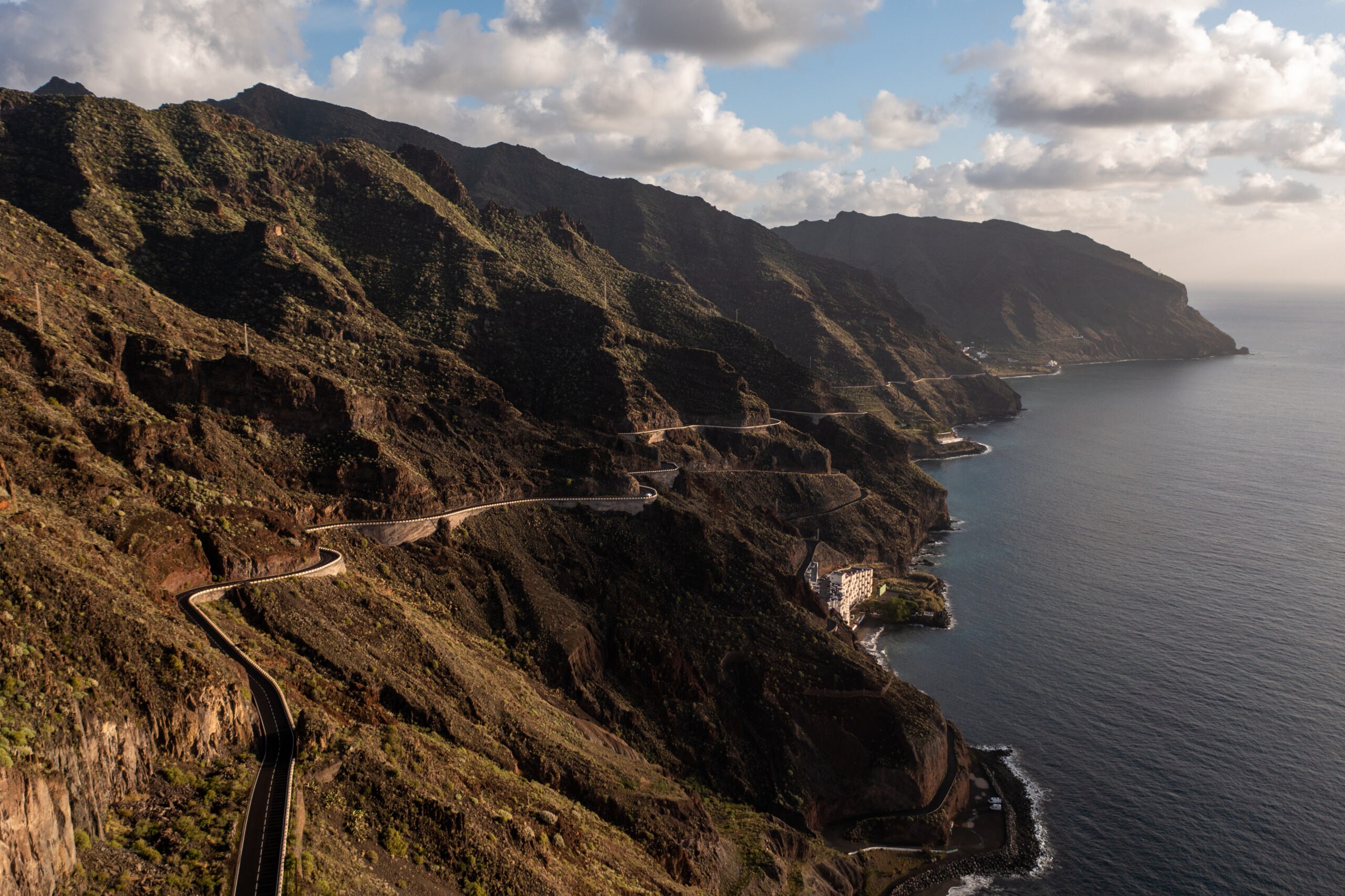
Mountain roads are a different matter. The TF-21 up to Teide, the TF-436 to Masca and the roads across the Anaga massif are narrow switchbacks with tight bends and big altitude changes. None of it is difficult if you drive calmly, but:
- Use engine braking on long descents — continuous braking can overheat the brakes.
- On narrow sections, the vehicle driving uphill has priority in practice, since restarting on a slope is harder.
- Allow far more time than the distance suggests — 40 km of mountain road is often over an hour.
- Watch for cyclists. Tenerife is a winter training ground for professional teams, and the climbs are full of them.
- Inside a cloud, visibility can drop to a few dozen metres — switch on your lights and slow down.
Parking: the colour code
The Spanish system is simple once you know the colours:
- White lines — free parking.
- Blue lines (zona azul) — paid parking; buy a ticket from the machine and display it, usually during shop hours.
- Yellow lines — no parking. Take it seriously: in resort towns cars do get towed.
In Puerto de la Cruz, La Laguna and Santa Cruz, underground car parks are the easiest option. In the mountains, park only in marked spaces — at popular trailheads they fill up before ten in the morning, so an early start solves two problems at once: parking and crowds.
Fuel and speed limits
Fuel in the Canary Islands is noticeably cheaper than on the European mainland thanks to the archipelago's separate tax regime — one of the few holiday costs here that is lower than you expect. Stations are plentiful along the motorways, but inland and inside Teide National Park there can be long stretches without one. The rule: fill up before heading into the mountains.
Speed limits: 120 km/h on motorways (many sections of the TF-1 and TF-5 are posted at 100, so read the signs), 90 km/h on open roads, 50 km/h in built-up areas and 30 km/h on single-lane urban streets. Speed cameras are less common than in much of Europe, but police check speeds regularly, especially on motorway exits.
A few things worth knowing in advance
- Air conditioning in the mountains — driving up Teide you will want the heating, not the cooling; the temperature swing is substantial.
- Salt and dust — cars parked near the ocean get a film of residue. That is normal and not damage.
- Punta de Teno — private car access is restricted during the day; a shuttle bus runs instead.
- Automatic or manual — an automatic gearbox makes the switchbacks much easier, and the price difference is usually small.
- Book early — in December, January, February and around carnival, cars on the island genuinely run out.
Summary
Driving on Tenerife is enjoyable: the roads are good, drivers are calm and distances are short. Everything else comes down to sensible planning and reading the contract before you sign it. If you would rather avoid a credit card deposit and paperwork at the airport, take a look at our fleet and prices or get in touch. The most common questions are also answered in our FAQ section.
See also: what to see in Tenerife and the weather month by month.
Planning a trip to Tenerife?
Browse our fleet — over 50 cars from economy to premium, delivered to Tenerife South (TFS) airport. No credit card required, free cancellation up to 3 days before pick-up.
See cars and prices